
0%

AC, geyser, fridge and fans: add up your units and size the solar plant that brings your Raipur bill close to zero.
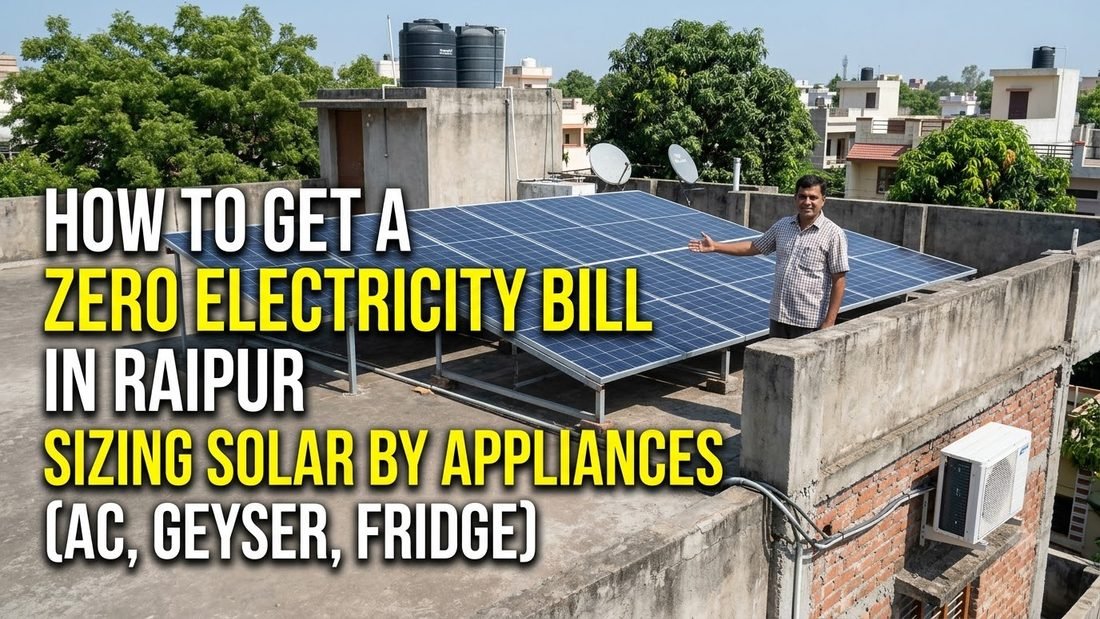
Image: Gupta Agro Solar (illustration).
How do you get a zero electricity bill in Raipur with rooftop solar? Add up the units used by your AC, geyser, fridge, fans and lights, size a grid-tied plant to match, and use net metering so exported units cancel imported ones. This complete guide to solar sizing by appliances in Raipur includes unit tables, two worked examples, costs, subsidy and why fixed charges usually remain.
Quick answer: a zero electricity bill in Raipur needs about 1 kW of solar for every 115 to 125 units of monthly use, so 400 units a month needs roughly 3.3 kW. Size from 12 months of bills and your appliances, use a grid-tied net-metered plant and expect fixed charges and duties to remain.
A zero electricity bill in Raipur means that the units your rooftop solar plant exports to the grid over a billing cycle are at least equal to the units you import, so the net energy charge is nil. In practice most households still pay a small amount for fixed charges, meter rent and duties, so the bill is "near zero" rather than exactly zero. The way to get there is to size solar from your real consumption, and the clearest way to do that is by adding up your appliances: AC, geyser, fridge, fans, lights, pump and the rest.
| Rule of thumb | Number (indicative) |
|---|---|
| Solar output per kW per month in Raipur | About 115 - 125 units on average (1,400 - 1,500 a year) |
| Area needed per kW | About 10 square metres of shadow-free roof |
| Units to offset 400 units a month | About 3.3 kW; a 3 to 3.5 kW plant |
| Fixed charges and duties | Usually remain even with zero net units |
Collect the last 12 months of bills and note monthly units. Summer months with air conditioners will be highest. Your annual total divided by 12 gives the average. Solar sizing should be based on the annual total because net metering adjusts excess in one month against deficit in another, though rules on carry-forward should be confirmed with CSPDCL.
| Average monthly units | Approximate solar needed | Roof area (approx.) |
|---|---|---|
| 150 units | 1.3 kW | 13 sq m |
| 250 units | 2.1 kW | 21 sq m |
| 400 units | 3.3 kW | 33 sq m |
| 600 units | 5.0 kW | 50 sq m |
| 900 units | 7.5 kW | 75 sq m |
Read solar size by electricity bill in Raipur and 3 kW vs 5 kW solar system.
This table shows indicative daily and monthly units for common Raipur home appliances. Real consumption depends on model, star rating, settings, hours and room size, so use it as a planning guide and cross-check against your bills.
| Appliance | Typical power | Hours per day (example) | Approx. units per month |
|---|---|---|---|
| 1.5 ton inverter AC (5-star) | About 1.0 - 1.5 kW running | 8 hours in summer | About 200 - 300 in peak months |
| Geyser (2 kW) | 2.0 kW | 1 hour | About 60 |
| Refrigerator (frost-free) | About 150 - 250 W compressor, cycling | 24 hours | About 30 - 50 |
| Ceiling fans (4) | About 50 - 75 W each | 10 hours | About 60 - 90 |
| LED lights (10) | About 9 W each | 6 hours | About 15 - 20 |
| Television and set-top box | About 100 - 150 W | 5 hours | About 15 - 25 |
| Water pump (0.5 - 1 HP) | About 0.4 - 0.75 kW | 0.5 hour | About 10 - 12 |
| Washing machine | About 0.5 kW | 1 hour (alternate days) | About 8 - 15 |
| Induction cooktop | About 1.5 - 2 kW | 1 hour | About 40 - 60 |
| Wi-Fi router, chargers, misc. | About 30 - 60 W | 24 hours | About 20 - 40 |
Air conditioners dominate summer bills. A household with two ACs, a fridge, fans, a geyser and lights can easily reach 450 to 700 units in peak summer months, which pushes the annual average higher than most people expect.
| Item | Units per month (approx.) |
|---|---|
| One 1.5 ton AC, 6 hours average over the year | About 110 |
| Fridge | About 40 |
| Fans and lights | About 100 |
| TV, router, chargers | About 45 |
| Geyser (winter), pump and washing machine | About 60 |
| Total | About 355 |
A plant of about 3 kW (producing roughly 345 units a month on average) comes close to offsetting this home. Adding a little margin for growth or choosing 3.5 kW makes a near zero bill realistic. A 3 kW plant costs about Rs 1.65 to 1.90 lakh before subsidy, and eligible homes can claim up to Rs 78,000.
| Item | Units per month (approx.) |
|---|---|
| Two 1.5 ton ACs, 6 hours average each | About 220 |
| Fridge and second fridge or freezer | About 80 |
| Fans and lights | About 140 |
| Geyser and induction cooktop | About 100 |
| TV, washing machine, pump, router, misc. | About 90 |
| Total | About 630 |
This household needs about 5 to 5.5 kW of solar for a near zero bill. The roof must have about 50 to 55 square metres of shadow-free space. See how many solar panels for a house in Raipur.
So a realistic goal is a bill that falls to the fixed-charge level. Confirm current net-metering and billing rules with CSPDCL before you set expectations.
| System | Zero-bill suitability | Notes |
|---|---|---|
| Grid-tied with net metering | Best for a near zero bill | Lowest cost; stops in a grid outage |
| Hybrid with battery | Possible, but costs more | Choose if outages are long and frequent |
| Off-grid | Not applicable to net metering | Used where there is no grid |
Most Raipur homes get the best return from grid-tied solar. If power cuts matter, consider a modest hybrid solar system or an inverter-UPS for essentials.
| System | Typical use | Indicative price before subsidy | Central subsidy (eligible homes) | Approx. net cost |
|---|---|---|---|---|
| 1 kW | Bill about Rs 600 - 1,000 | Rs 60,000 - 70,000 | Rs 30,000 | Rs 30,000 - 40,000 |
| 2 kW | Bill about Rs 1,500 - 2,000 | Rs 1.2 - 1.4 lakh | Rs 60,000 | Rs 60,000 - 80,000 |
| 3 kW | About 350 - 400 units a month | Rs 1.65 - 1.90 lakh | Rs 78,000 | Rs 87,000 - 1.12 lakh |
| 5 kW | About 600 units or several ACs | Rs 2.6 - 3.0 lakh | Rs 78,000 (cap) | Rs 1.8 - 2.2 lakh |
| 10 kW | Shops, offices, small institutions | Rs 5.0 - 5.8 lakh | Not applicable (commercial) | Rs 5.0 - 5.8 lakh |
Eligible homes receive Rs 30,000 per kW for the first 2 kW and Rs 18,000 for the third kW, a maximum of Rs 78,000 for 3 kW and above through PM Surya Ghar, credited after commissioning. A reported Chhattisgarh state top-up should be confirmed in writing. A 3 kW plant saving about Rs 2,500 to 3,000 a month typically pays back in three to four years after subsidy. See solar subsidy in Raipur.
See solar panel cleaning in Raipur.
Read next: Does Rooftop Solar Increase Property Value in Raipur?, How to Get a Zero Electricity Bill in Raipur, Solar for Temples, Trusts, Gaushalas and NGOs, Solar for Cold Storage, Mushroom and Dairy Units, Solar Panel Warranty Claim in Raipur. Also see solar in Raipur, solar subsidy in Raipur, best solar company in Raipur and top 10 solar companies in Raipur.
Gupta Agro Solar sizes systems from your bills and appliance load, names every component in writing and handles net-meter and subsidy paperwork for homes across Raipur.
Gupta Agro Solar is based at C-29, Sector 3, Devendra Nagar, Raipur, and has served homes, businesses and farms across Chhattisgarh since 2010. Call 083051 31420, visit the contact page or see our solar company in Chhattisgarh page, best solar company in Chhattisgarh guide and home page.
| Month group | Typical household pattern | Solar output (3 kW, approx.) | Likely net position |
|---|---|---|---|
| March - May | AC use rises; consumption peaks | About 400 - 450 units a month | Roughly balanced for a 400-unit household |
| June | Hot with pre-monsoon cloud | About 330 - 380 units | Slight deficit for AC-heavy homes |
| July - September | Monsoon; lower solar, moderate consumption | About 250 - 300 units | Often a deficit offset by earlier credit |
| October - November | Clean skies, festival lighting | About 380 - 400 units | Surplus, building credit |
| December - February | Cool, geyser use | About 340 - 380 units | Usually near balance |
| Cooling setup | Extra units in peak months (approx.) | Extra solar needed |
|---|---|---|
| One 1.5 ton inverter AC | 150 - 250 | About 1.5 - 2 kW |
| Two 1.5 ton ACs | 300 - 500 | About 3 - 4 kW |
| Three ACs plus cooler | 450 - 700 | About 4.5 - 6 kW |
Because air conditioners run mostly in daytime, solar covers them well. Compare this table with your own bills before choosing between a 3 kW and a 5 kW system.
Your electricity bill under net metering shows imported units, exported units and the net figure. Exported units earn credit that is adjusted against imports, and any unadjusted credit is carried forward or settled according to the utility's rules. Check the statement every month: if exports are lower than expected, clean the panels and check the monitoring app. Confirm current rules, settlement periods and rates with CSPDCL. See CSPDCL approvals and timeline explained.
That is the complete guide to zero electricity bill in raipur. For a method to compare providers, see how to build your own list of the top 10 solar companies in Raipur. If you are choosing a provider, start with a solar company in Raipur that is registered for the scheme, and compare it using the best solar company in Raipur questions. For subsidy, see PM Surya Ghar Yojna in Raipur and our solar subsidy in Raipur help. Our solar installation in Raipur crews work across the city, the solar in Raipur guide covers costs and the solar Raipur guide covers neighbourhoods. Browse the full blog for more.
Install a grid-tied rooftop solar plant sized from your annual units, under net metering, so exported units cancel imported units; fixed charges may remain.
About 1 kW per 115 to 125 units of monthly consumption; 400 units a month needs roughly 3.3 kW.
Roughly 1.0 to 1.5 kW while running; at 8 hours a day it can use about 200 to 300 units a month in peak summer.
A 2 kW geyser used for one hour a day consumes about 60 units a month.
A frost-free fridge typically uses around 30 to 50 units a month.
Usually not, because fixed charges, meter rent and duties may remain; the net energy charge can be zero.
A home with two ACs, a geyser and a fridge often needs about 5 to 5.5 kW.
Yes, but at lower output; credit from sunnier months helps under net metering, subject to utility rules.
No. Grid-tied net metering is enough; batteries only add backup during outages.
About 10 square metres of shadow-free area per kW; 3 kW needs about 30 to 33 square metres.
Up to Rs 78,000 for eligible homes with 3 kW or more under PM Surya Ghar, credited after commissioning.
Gupta Agro Solar offers a free survey and bill-based sizing; call 083051 31420.
Visit C-29, Sector 3, Devendra Nagar, Raipur, Chhattisgarh 492001, call 083051 31420 or send your details online for a free survey and a written quotation, with the subsidy worked out. Our solar installation in Raipur team replies the same working day.
A good solar company in Raipur survey comes first. Read about solar in Raipur, compare firms with our best solar company in Raipur questions and see how solar installation in Raipur works in your solar Raipur neighbourhood. Want help with solar subsidy in Raipur or PM Surya Ghar Yojna in Raipur? Our team handles the whole file. Quick links: solar in Raipur, best solar in Raipur, rooftop solar in Raipur, solar water heater in Raipur and solar installation in Raipur. Browse every article on the solar blog, or see our solar services.