
0%

The subsidy stops at 3 kW, but your bill may not. Here is how to choose between the two most popular home sizes.
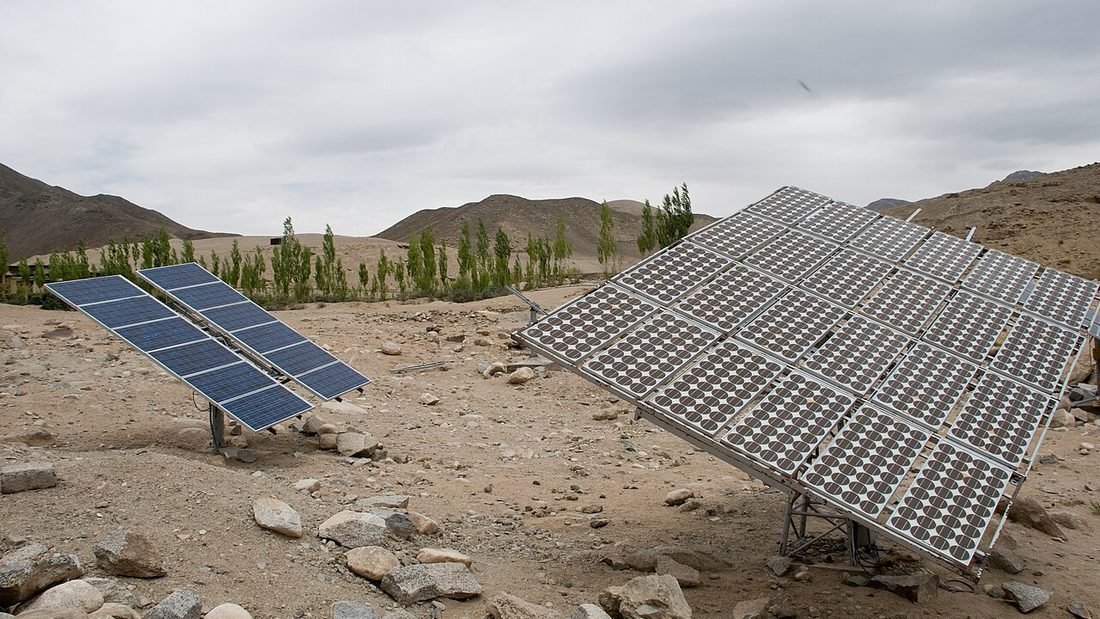
Image: Solar panels near Leh (4336619499) by Kiran Jonnalagadda from Bangalore, India, CC BY-SA 2.0, via Wikimedia Commons.
Among Raipur homes, two sizes dominate quotes: 3 kW and 5 kW. Both work. The question is which one earns more for your money, given that the central subsidy stops at 3 kW. This guide puts the numbers side by side so you can choose with a calculator instead of a sales pitch. Use it alongside our wider overview of solar in Raipur.
Quick answer: choose 3 kW if you use up to about 400 units a month. Choose 5 kW if you use 500 to 650 units a month and want to remove most of the bill. The first 3 kW is heavily subsidised; the extra 2 kW is not, but it can still pay back within five or six years.
| Factor | 3 kW system | 5 kW system |
|---|---|---|
| Indicative cost before subsidy | Rs 1.65 - 1.90 lakh | Rs 2.6 - 3.0 lakh |
| Central subsidy | Rs 78,000 | Rs 78,000 (cap) |
| Net cost after central subsidy | Rs 87,000 - 1.12 lakh | Rs 1.8 - 2.2 lakh |
| Roof area | About 30 sq m | About 50 sq m |
| Monthly generation | 360 - 400 units | 600 - 675 units |
| Typical monthly saving | Rs 2,400 - 3,000 | Rs 4,000 - 5,000 |
| Typical annual saving | Rs 29,000 - 36,000 | Rs 48,000 - 60,000 |
| Simple payback | About 3 - 4 years | About 4 - 5 years |
| Best for | Homes using up to ~400 units | Homes using ~500 - 650 units |
The central subsidy is Rs 30,000 per kW for the first 2 kW and Rs 18,000 for the third kW, with a cap of Rs 78,000. A 3 kW system receives the maximum. A 5 kW system receives the same Rs 78,000, so the average subsidy per kW falls. That does not make 5 kW a bad choice. It means the extra two kilowatts have to justify themselves through savings alone. If Chhattisgarh's state top-up applies to your connection, it adds to the 3 kW advantage, so confirm current slabs with CSPDCL or read PM Surya Ghar Yojana in Chhattisgarh.
Subtract the 3 kW price from the 5 kW price and you get the cost of the extra capacity: roughly Rs 95,000 to 1.1 lakh, with no subsidy. That extra 2 kW generates about 240 to 270 units a month. At a domestic tariff in the higher slabs, which is where marginal units are billed, that can save Rs 1,600 to 2,000 a month, or about Rs 19,000 to 24,000 a year. Marginal payback on the extra 2 kW is therefore about four to six years, which is still attractive against a 25-year life, but slower than the first 3 kW.
| If your monthly use is | Choose | Reason |
|---|---|---|
| Up to 150 units | 1 - 2 kW | Small bills; subsidy per kW is highest |
| 150 - 400 units | 2 - 3 kW | Covers most of the bill; full subsidy at 3 kW |
| 400 - 500 units | 3 - 4 kW | Tune capacity to the bill and roof |
| 500 - 650 units | 5 kW | Removes most of the bill despite capped subsidy |
| Above 650 units | 6 kW or more | Check sanctioned load and roof |
A family in Shankar Nagar uses 520 units a month. A 3 kW system generates about 380 units, leaving 140 units to buy from CSPDCL. A 5 kW system generates about 640 units, which would exceed consumption in many months and bank the surplus under net metering. The 3 kW option has a net cost of around Rs 1.0 lakh and leaves a small bill; the 5 kW option costs around Rs 2.0 lakh and removes the bill almost entirely. Both are reasonable. The 3 kW option has the faster payback; the 5 kW option has the larger total saving over 25 years and protects against future tariff increases.
| Measure over 25 years | 3 kW | 5 kW |
|---|---|---|
| Approx. generation | About 1,00,000 units | About 1,65,000 units |
| Net cost after central subsidy | Rs 87,000 - 1.12 lakh | Rs 1.8 - 2.2 lakh |
| Total electricity saving at today's tariff (indicative) | Rs 7 - 8 lakh | Rs 11 - 14 lakh |
| Net gain after cost (indicative) | Rs 6 - 7 lakh | Rs 9 - 12 lakh |
Both are strong returns. The 5 kW system produces a larger total gain, while the 3 kW system produces a better gain per rupee invested. These figures are indicative and ignore inverter replacement, degradation and tariff changes, which push the picture in different directions. If tariffs rise, both improve.
A hybrid system must charge the battery as well as run the home. A household that wants backup may need a slightly larger array than one that only wants to cut the bill. Ask the installer to model the daily energy balance with the battery included. A 3 kW array with a 5 kWh battery is a common pairing, and a 5 kW array with a 10 kWh battery suits larger homes. See solar battery storage for home in Raipur.
If you are unsure, install 3 kW now and design the structure, cabling and inverter so that adding capacity later is simple. Ask whether the inverter can accept additional panels or whether a second inverter would be needed. Adding capacity later needs new paperwork and, if the extra is beyond 3 kW, brings no extra subsidy, but it spreads the cost and lets real consumption guide the decision. A little foresight at design time, such as leaving roof space and spare conduit, makes expansion cheaper.
One more point of judgement: if your household has been trimming consumption because bills hurt, your current use understates what you will use once electricity is cheaper. Allow for a small rebound in the way you size, rather than sizing to a bill you have been rationing.
Read how many solar panels a house needs to turn kW into panel count, and solar panel price in Raipur to understand cost. A solar company in Raipur can model both sizes for your bills, and our rooftop solar installation in Raipur service handles survey to commissioning. For the scheme, see PM Surya Ghar Yojana in Raipur and solar subsidy apply online in Chhattisgarh. If you are comparing firms, use our guide to the best solar installer in Raipur. Readers outside Raipur can start with solar in Chhattisgarh, solar company in Chhattisgarh and rooftop solar installation in Chhattisgarh.
A 3 kW system suits homes using about 250 to 400 units a month and gets the full central subsidy. A 5 kW system suits homes using about 500 to 650 units a month, typically with several air conditioners. Choose by consumption.
No. The central subsidy is capped at Rs 78,000, reached at 3 kW. The extra 2 kW of a 5 kW system is unsubsidised, so it pays back through bill savings alone.
About 30 square metres for 3 kW and 50 square metres for 5 kW, assuming shadow-free space and walkways.
A 3 kW system usually pays back in about three to four years after the subsidy. A 5 kW system takes slightly longer on average because only part of its cost is subsidised, but it saves more each month.
Net metering capacity is linked to your sanctioned load, so a 5 kW system may need a load enhancement. Check this before you place an order.
We size from twelve months of bills, not guesses. Visit C-29, Sector 3, Devendra Nagar, Raipur, Chhattisgarh 492001, call 083051 31420 or request a free survey and we will show both options side by side.
Looking for the best solar company in Raipur? See how solar in Raipur works, check the solar Raipur locality guide and book solar installation in Raipur with a trusted solar company in Raipur. Our checklist for the best solar company in Raipur shows what to ask. Browse every article on the solar blog, or see PM Surya Ghar Yojana in Raipur and our solar services.
A side-by-side comparison with net cost, annual saving and payback for your actual consumption.