
0%

Water tanks, satellite dishes and stair covers cast long shadows. Here is how to lay out an array that avoids them.
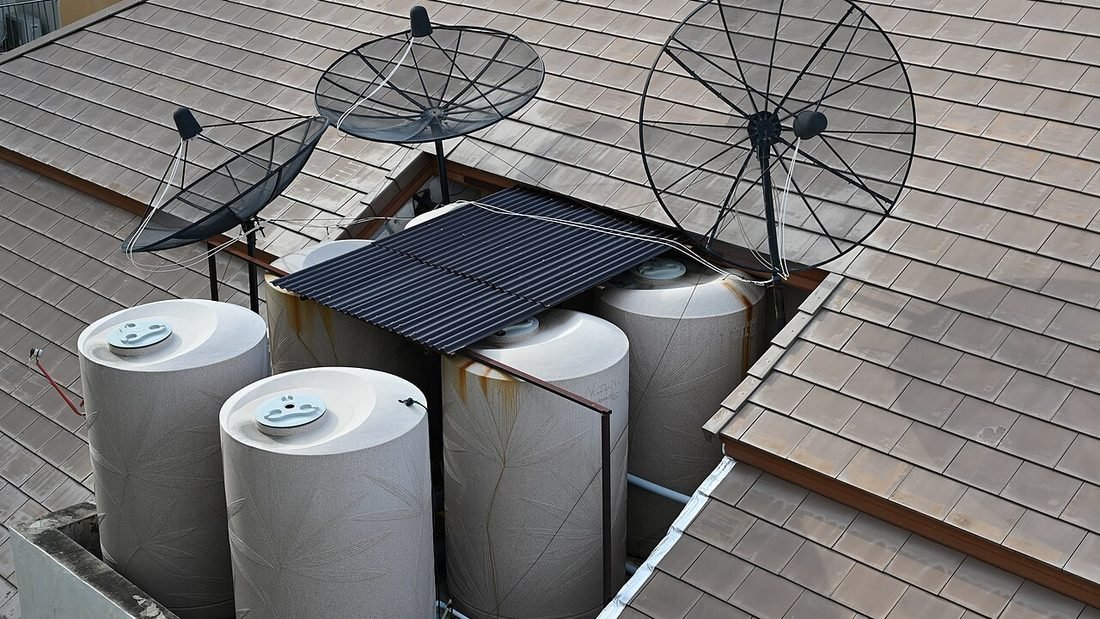
Image: DZ6 2947 Rooftop view in Pattaya water storage tanks and satellite ... by PattayaPatrol, CC BY-SA 4.0, via Wikimedia Commons.
Walk onto almost any roof in Raipur and you will find a cluster of plastic water tanks, a dish or two, a stair cover and perhaps a parapet that is higher than it needs to be. Each casts a shadow, and shadows are the single most common reason solar systems underperform. This guide explains how to lay out solar panels around water tanks and other obstructions so that you keep your output.
Quick answer: keep panels south of obstructions, leave clear gaps equal to at least 1.5 to 2 times the obstruction's height, shift tanks to the north side where possible and ask for a shading analysis before design.
Panels in a string are wired in series. If one is shaded, current through the whole string falls toward what that panel can deliver. A shadow covering a tenth of one panel can cost far more than a tenth of one panel's output. That is why layout matters more than on-paper capacity.
| Obstruction height | Approx. shadow length in winter morning or afternoon | Approx. shadow at midday in winter |
|---|---|---|
| 1 m (parapet) | 2 - 4 m | 1 - 1.5 m |
| 1.5 m (tank on stand) | 3 - 6 m | 1.5 - 2 m |
| 2.5 m (stair cover) | 5 - 10 m | 2.5 - 3.5 m |
| 3 m (tank on tall stand) | 6 - 12 m | 3 - 4 m |
These are rough illustrations because shadow length changes with date and hour. Winter is the worst case, since the sun is lowest. A proper shading analysis uses the exact roof geometry.
| Option | How it works | Pros | Cons |
|---|---|---|---|
| Place array south of obstructions | Tanks and stair cover on the north side | No shade, simplest | Needs enough south-side area |
| Move the tank | Relocate tanks to a corner away from the array | Cheap, frees best area | Needs plumbing work |
| Raise the structure | Lift panels above the obstruction's shadow | Keeps area usable | More steel, wind load |
| Split the array | Place groups on separate roof areas | Works around obstacles | More cabling, more strings |
| Use optimisers or microinverters | Limit the effect of partial shade | Tolerates some shade | Higher cost, more electronics |
On a flat roof, panels sit in tilted rows. If rows are too close, the front row shades the back one in winter mornings and afternoons. Spacing depends on tilt and panel height; a designer calculates it so that rows are clear for several hours around midday on the shortest day. Tight spacing fits more panels but loses yield; generous spacing gives cleaner output with fewer panels.
A home has a 10 m by 10 m roof. Two tanks stand 1.5 m tall in the middle, a 2.5 m stair cover sits at the north-east corner and a dish is fixed on the south wall. The owner wants 5 kW, which needs about 50 square metres. A naive layout fills the south half and loses output to tank shadows in winter. The designer instead asks the plumber to shift the tanks to the north-west corner, leaves a 6 m clear band south of the stair cover and rotates the array to avoid the dish. The result is a clean 5 kW with no shaded panels. The total extra cost is the plumbing change, a small fraction of what a year of lost generation would cost.
| Scenario | Typical effect on yearly output |
|---|---|
| No shade | Baseline |
| Small shadow on one panel for a few hours in winter | A few percent on a string-inverter system |
| Tank shadow crossing a row most mornings | Noticeable loss, often 5 to 15 percent |
| Heavy shade from a taller neighbour | Large loss; capacity may need to be reduced |
These are illustrative; a shading analysis with exact geometry gives your own figure.
If shade cannot be avoided, per-panel electronics let each panel work independently. They cost more and add rooftop electronics that must survive heat, so use them only where the shade loss would exceed their cost over the system's life. Ask the installer to show the expected generation with and without them.
A shaded panel costs you every day; a shifted tank costs you once. For the fundamentals of solar in Raipur, read our cost and savings guide, and use the solar Raipur locality guide for your neighbourhood. A local solar company in Raipur should survey your roof, our checklist for the best solar company in Raipur shows what to ask, and our solar installation in Raipur team handles the work. Browse all solar guides or read about PM Surya Ghar Yojana in Raipur.
Even a small shadow on one panel can reduce the output of the whole string, because panels in series are limited by the weakest one. Optimisers or microinverters limit the effect but add cost.
Yes, on the side where the tank does not cast a shadow, usually the north side of the array in Raipur, or by raising the structure.
A common rule is at least 1.5 to 2 times the obstruction's height to the north of the array, but a shading analysis gives the real figure for your roof.
Often yes, and it is the cheapest fix. Shifting a tank to the north side can free the best part of the roof.
The gap between rows of tilted panels so that one row does not shade the next. It depends on tilt and the sun's lowest winter angle.
Visit C-29, Sector 3, Devendra Nagar, Raipur, Chhattisgarh 492001, call 083051 31420 or send your details online for a free survey and a written quotation. Our solar installation in Raipur team replies the same working day.
Looking for the best solar company in Raipur? See how solar in Raipur works, check the solar Raipur locality guide and book solar installation in Raipur with a trusted solar company in Raipur. Our checklist for the best solar company in Raipur shows what to ask. Browse every article on the solar blog, or see PM Surya Ghar Yojana in Raipur and our solar services.
Roof survey with a shadow study and a layout that avoids tanks, dishes and stair covers.