
0%
Three different warranties, one maintenance routine, and the after-sales service that decides whether your system still performs in year twenty.
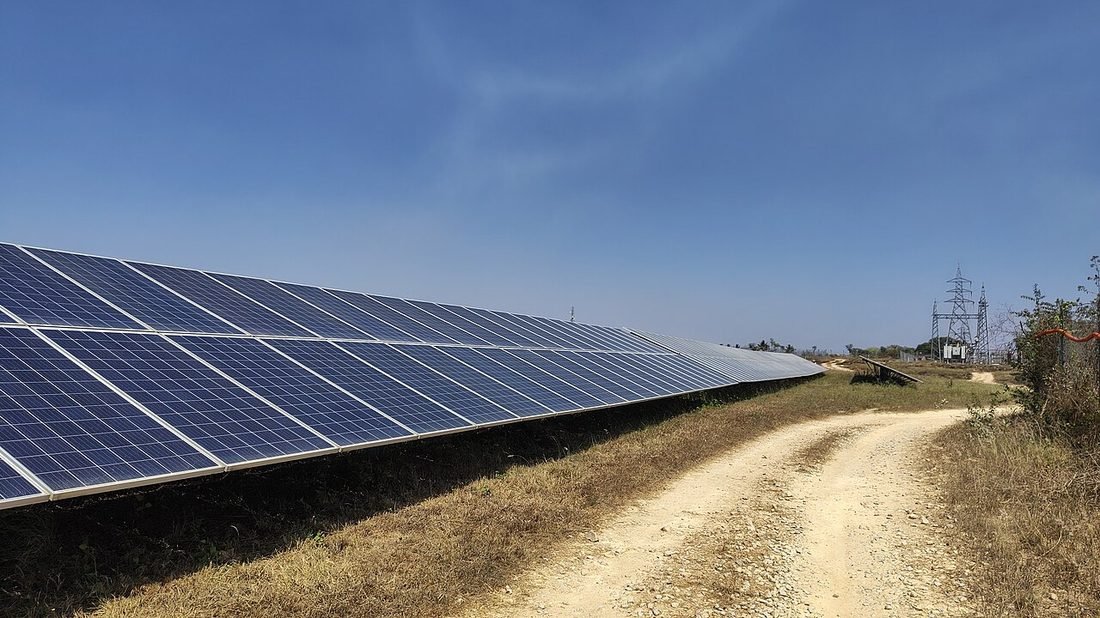
Image: Solar panels in India by User: Manjunatha G, WELL Labs, CC BY-SA 4.0, via Wikimedia Commons.
Warranty is the part of a solar quotation everyone nods at and nobody reads. Then, eight years later, an inverter fails and the difference between a good installer and a cheap one becomes very concrete.
This guide explains what each warranty on a solar panel installation in Raipur actually promises, what maintenance a system needs in Chhattisgarh's dust and heat, and what after-sales service you should insist on before you sign.
A solar system is not a single product, so it does not carry a single warranty. Any installer telling you "25 years, everything covered" is simplifying to the point of being misleading.
This is the headline figure, and it is a promise about output, not about the panel surviving. A typical tier-1 module guarantees around 97 to 98 per cent of rated output at the end of year one, then no more than roughly 0.5 per cent degradation per year, landing at 80 to 87 per cent of nameplate capacity in year 25.
In practice, a 540 W panel installed in Raipur today should still be producing well over 430 W in 2051. That is the warranty that makes solar a twenty-five-year investment rather than a ten-year appliance.
Separate and often overlooked. This covers manufacturing defects - delamination, junction-box failure, frame corrosion, cell cracking not caused by impact. It is shorter than the performance warranty because it is about build quality rather than output curve.
The inverter is the component most likely to need replacing during your system's life. Standard warranties run 5 years, with 7 to 10 years available on better brands, sometimes as a paid extension. Because the inverter is the single point of failure for the whole array, this is the worst place in a solar system to economise.
Our inverter and battery page sets out what we fit and why.
Here is the one that actually distinguishes installers. Panel and inverter warranties come from manufacturers and are identical whoever fits them. The workmanship warranty comes from the company that mounted the structure, ran the cable and dug the earth pit.
If a clamp works loose in a pre-monsoon squall, water tracks into a DC connector, or an earth pit dries out, no manufacturer will help you. Gupta Agro Solar provides a five-year workmanship warranty in writing, covering mounting structure integrity, cabling, earthing and weatherproofing.
| Component | Warranty Period | What It Covers | Backed By |
|---|---|---|---|
| Solar panels - performance | 25 years | Guaranteed minimum output over time | Manufacturer |
| Solar panels - product | 10 - 12 years | Manufacturing defects | Manufacturer |
| Inverter | 5 - 10 years | Electronics failure | Manufacturer |
| Mounting structure | 10 - 15 years | Galvanising and corrosion | Fabricator |
| Battery (hybrid only) | 3 - 10 years | Capacity retention | Manufacturer |
| Workmanship | 5 years | Installation quality, leaks, earthing | Gupta Agro Solar |
Less than people fear, but more than nothing. Rooftop solar has no moving parts, so maintenance is essentially cleaning plus periodic electrical inspection.
Raipur has a serious dust problem. Construction along Ring Road, agricultural dust drifting in from surrounding districts and a long dry season from October to June mean panels soil faster here than in coastal cities.
A soiled array loses 15 to 25 per cent of its output, and in extreme cases more. That is the difference between a 3 kW system saving you Rs 3,000 a month and saving you Rs 2,300.
A qualified technician should check, at least half-yearly:
Every system we commission includes remote monitoring on your phone. Five minutes a week is enough: compare today's generation against the same week last month. A sudden 20 per cent drop usually means soiling; a gradual decline across one string usually means a connector or a shading change, such as a tree that has grown.
An annual maintenance contract is optional but sensible, particularly for customers who do not want to go on the roof themselves.
| System Type | Typical Annual Cost | Visits Per Year |
|---|---|---|
| Residential up to 5 kW | Rs 3,000 - 4,500 | 4 - 6 |
| Residential 5 - 10 kW | Rs 4,500 - 6,000 | 6 |
| Commercial 10 - 50 kW | Quoted per kW | 6 - 12 |
| Industrial above 50 kW | Quoted per kW | Monthly |
A standard AMC from us covers scheduled cleaning, half-yearly electrical inspection, earth pit testing, inverter health check, an annual performance report against expected generation, and priority fault response. Full detail is on our maintenance and support page.
A solar water heater in Raipur needs even less attention than a PV array - collector cleaning two or three times a year, an annual check of the cold-water inlet and, in hard-water areas, periodic descaling of the tank. Evacuated tube collectors should be inspected for cracked tubes after hailstorms.
Farm systems take more punishment. Panels need cleaning more often because of field dust, controller enclosures must stay sealed against moisture, and the pump itself should be checked annually for impeller wear. Our solar pump guide covers the farming context.
Lithium batteries need almost nothing beyond ventilation and a temperature-controlled location. Lead-acid banks need electrolyte checks every quarter and terminal cleaning. Either way, keep the installation out of direct afternoon sun - heat is what kills batteries in Chhattisgarh.
Ask any prospective installer these five questions before you sign:
All our solar panels carry a 25-year performance warranty, and our installation workmanship is covered as well. Inverters typically carry 5 to 10 years, and mounting structures are warranted against corrosion. Our customers' peace of mind matters to us, so every warranty is handed over in writing at commissioning.
Yes, comprehensively. We provide regular maintenance, performance monitoring support and prompt fault attendance. If you ever face an issue, call us - our service team covers Raipur and the surrounding districts and we are always here to help our customers.
Every two to four weeks through the dry season from October to June, and after any dust storm. Raipur's airborne dust is heavier than most Indian cities, and soiled panels can lose 15 to 25 per cent of their output. The monsoon largely cleans them for you.
A residential annual maintenance contract typically runs Rs 3,000 to Rs 6,000 a year depending on system size, covering scheduled cleaning, electrical inspection, performance review and priority fault response. Commercial AMCs are quoted per kW.
The product warranty covers manufacturing defects in the panel itself, usually 10 to 12 years. The performance warranty guarantees output - typically at least 80 to 87 per cent of rated capacity after 25 years. They are separate promises and you need both.
A solar system is only as good as the company still answering the phone in year eight. We have been at the same Devendra Nagar address since 2010, and a large part of our week is spent maintaining systems we installed a decade ago. That is the test worth applying to any installer you are considering.
Visit us at C-29, Sector 3, Devendra Nagar, Raipur, Chhattisgarh 492001, call 083051 31420, or send us your details online. Our team answers every enquiry from Raipur and across Chhattisgarh, usually on the same working day.
We service systems we did not install, across Raipur and Chhattisgarh - inspection, cleaning, fault diagnosis and annual maintenance contracts.