
0%

Quick, honest answers to the 50 questions people ask about the best solar in Raipur.
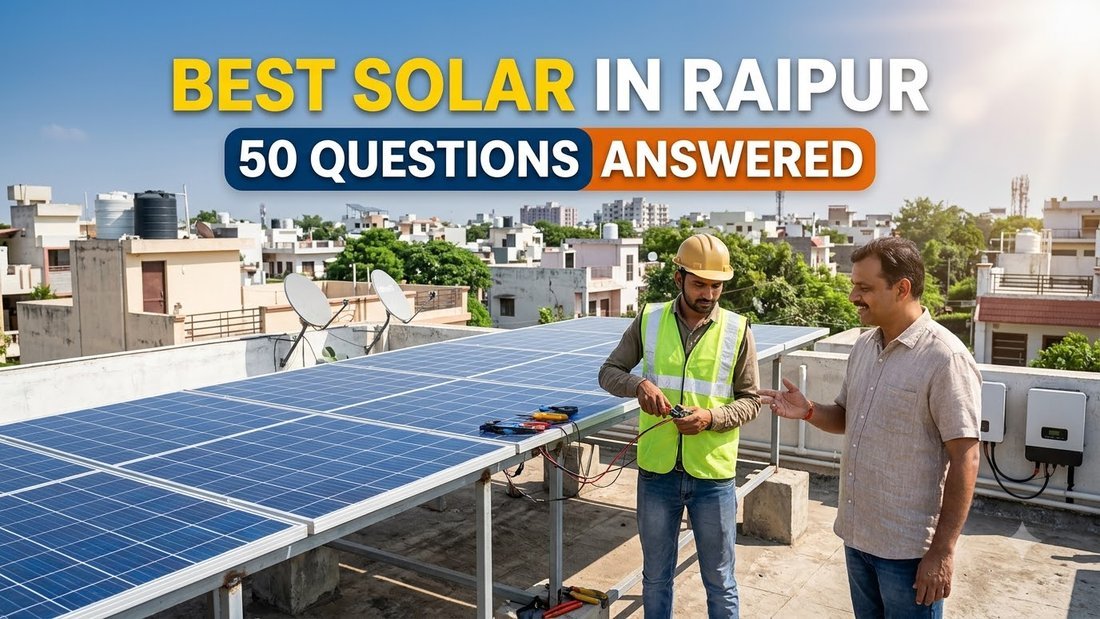
Image: Gupta Agro Solar (illustration; brand names and prices shown are not endorsements or quotations).
Here are the 50 questions people ask most about the best solar in Raipur, answered plainly. Use this page as a quick reference when you are comparing quotes, planning a subsidy application or deciding between 3 kW, 5 kW and hybrid. Every answer is a short, practical summary; follow the links for the full guides on the best solar in Raipur.
Quick answer: the best solar in Raipur is the system sized to your bills, built with proven equipment, installed by a registered local installer who names components in writing and handles the subsidy, and then maintained with regular cleaning and checks.
The 50 questions follow below. If yours is not answered, ask us or visit C-29, Sector 3, Devendra Nagar, Raipur. Gupta Agro Solar has helped Raipur homes, businesses and farms since 2010; see the home page and our solar in Raipur guide.
Those 50 answers should help you choose the best solar in Raipur. For a method to compare providers, see how to build your own list of the top 10 solar companies in Raipur. If you are choosing a provider, start with a solar company in Raipur that is registered for the scheme, and compare it using the best solar company in Raipur questions. For subsidy, see PM Surya Ghar Yojna in Raipur and our solar subsidy in Raipur help. Our solar installation in Raipur crews work across the city, the solar in Raipur guide covers costs and the solar Raipur guide covers neighbourhoods. Browse the full blog for more.
For most homes it is a 2 to 5 kW grid-tied rooftop system sized from twelve months of bills, with proven equipment, a registered installer and the subsidy claimed correctly.
For most owner-occupied homes with sunny roofs and bills above about Rs 2,000 a month, yes; payback is often three to four years after subsidy.
About 300 clear days a year, so 1 kW produces roughly 1,400 to 1,500 units annually.
Roughly Rs 1.4 to 1.9 lakh before subsidy depending on equipment and scope.
Roughly Rs 2.2 to 3.0 lakh before subsidy.
Up to Rs 30,000 per kW for the first 2 kW and Rs 18,000 for the third kW, capped at Rs 78,000 for eligible homes under PM Surya Ghar.
A state top-up for domestic consumers has been reported; confirm amounts and conditions with CREDA or your vendor in writing.
On the national PM Surya Ghar portal, with your CSPDCL consumer number.
No, portal registration is free.
After commissioning and inspection, typically around a month later, into your bank account.
No; installing first can put the subsidy at risk, so register and follow the portal steps before work begins.
An installer listed on the national portal for your district, required for subsidised systems.
Domestic content requirement; subsidised systems should use modules made with domestic cells, so ask for the certificate.
Divide your average monthly units by about 120 to estimate kW.
About six to seven modern 500 W panels.
Roughly 30 to 35 square metres of shadow-free area.
A system connected to the grid with net metering and no battery; it shuts down in a power cut.
A system with a battery and special inverter that keeps selected circuits running in outages.
A standalone system with batteries, used where there is no reliable grid.
No; it shuts down for safety unless it is a hybrid system.
A bi-directional meter records units imported and exported, so exports offset your consumption.
From days to a few weeks after inspection, depending on the division.
Mainstream mono PERC or TOPCon modules from established manufacturers with strong warranties and DCR compliance.
They are increasingly rare; most new rooftops use mono modules.
Typically 25 years or more with gradual output decline, backed by performance warranties.
Often 8 to 12 years; many owners replace it once during the system's life.
Only if power cuts are frequent or long and you want backup; otherwise grid-tied costs less.
Lithium costs more but usually lasts longer and offers more usable capacity, so it often wins on cost per cycle.
Yes at reduced output; monsoon months produce less.
Yes, by roughly 0.3 to 0.4 per cent per degree of cell temperature above 25, which good design allows for.
Every three to four weeks in the dry season and after storms.
Yes, with plain water and a soft cloth or squeegee; avoid pressure jets and abrasive pads.
Rarely; fixed charges and taxes remain.
Often about three to four years for homes after subsidy, longer for small bills or hybrid systems.
Banks offer rooftop solar loans at low rates for some systems; confirm current terms and avoid EMIs you cannot afford.
Only with the owner's written consent; owners usually benefit most.
Yes, usually for common areas with a society resolution and roof consent.
Yes; commercial tariffs make payback attractive, though the household subsidy generally does not apply.
A company handling engineering, procurement and construction of a solar plant.
One to three days on site for a home, and one to three months overall including approvals.
Not with sealed foundations and a sound waterproofing layer; get a written leak warranty.
Periodic cleaning, a weekly check of the app and an annual inspection.
An annual maintenance contract for cleaning, inspection and support.
Possibly, depending on inverter capacity, roof space and approvals.
Yes; add roughly 1.5 kW of solar per 1,000 km a month of car use.
Check portal registration, survey quality, named equipment, written warranties, milestone payments and local references.
A modest advance is common, but never the full amount; tie payments to milestones.
Read detailed reviews, call recent local customers, check registration and compare generation with the promise.
It can make a home more attractive to buyers who value low bills, though a sale premium is not guaranteed; keep documents and generation records to show.
Yes, free site surveys and written quotations across Raipur from C-29, Sector 3, Devendra Nagar.
Visit C-29, Sector 3, Devendra Nagar, Raipur, Chhattisgarh 492001, call 083051 31420 or send your details online for a free survey and a written quotation, with the subsidy worked out. Our solar installation in Raipur team replies the same working day.
Next, talk to a solar company in Raipur about solar installation in Raipur. Our solar in Raipur guide explains costs, the solar Raipur guide covers your area and the best solar company in Raipur checklist helps you choose. Want help with solar subsidy in Raipur or PM Surya Ghar Yojna in Raipur? Our team handles the whole file. Quick links: solar in Raipur, best solar in Raipur, solar for home in Raipur, PM Surya Ghar Yojana in Raipur and solar pump in Raipur. Browse every article on the solar blog, or see our solar services.