
0%

From monsoon output to subsidy fears, here is what is true, what is half-true and what is simply wrong about rooftop solar.
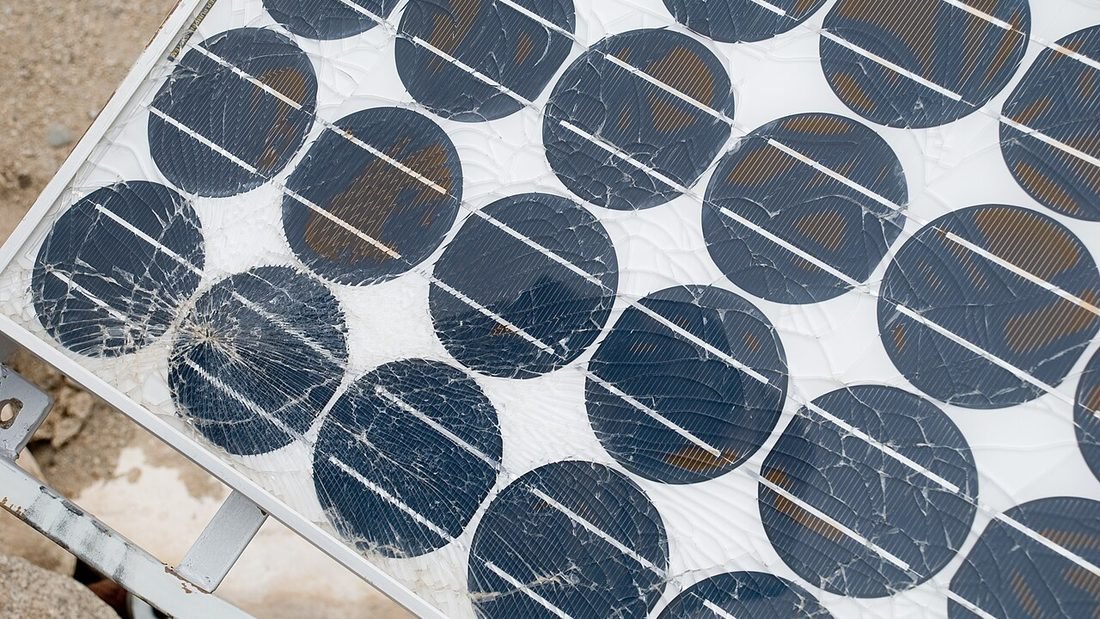
Image: Cracked solar panel near Leh (4336613925) by Kiran Jonnalagadda from Bangalore, India, CC BY-SA 2.0, via Wikimedia Commons.
Solar attracts a lot of folklore. Some of it comes from salespeople, some from half-remembered stories, some from outdated technology. Because wrong beliefs lead to bad decisions, here are twelve common claims about solar in Chhattisgarh and the facts behind each, written for homeowners in Raipur and across the state.
Quick answer: most myths are exaggerations of a small truth. Solar works in the monsoon at lower output, needs light maintenance, does not give a literally zero bill and does not damage a sound roof when installed well.
Fact: It works at reduced output. On heavily overcast days, expect roughly 30 to 50 per cent of peak, and rain also cleans the panels. July and August are the weakest months, but spring, autumn and winter more than make up for them. Raipur has about 300 clear days a year, and a kilowatt of capacity produces around 1,500 units annually.
Fact: It can remove most of the bill, commonly 70 to 90 per cent, but fixed charges remain and months of unusually high use can leave a balance. Be wary of anyone who guarantees zero.
Fact: The central subsidy is credited to your bank account after commissioning and inspection. You pay the vendor the full price first. The state top-up, where applicable, is disbursed through the distribution company.
Fact: It needs little, not none. Dust can cut output 15 to 25 per cent if panels are never cleaned, and inverters, connections and earthing need annual checks. See our solar maintenance checklist.
Fact: Panels carry a 25-year performance warranty and typically last 30 years or more. The inverter is the part more likely to need replacement, often after 10 to 15 years.
Fact: A sound roof properly sealed and fitted with the correct structure is not damaged by solar. Leaks arise from poor sealing, weak fixings or an old roof. Check the installer's waterproofing method and warranty.
Fact: A grid-tied system shuts down during an outage for the safety of line workers. To have power in a cut you need a hybrid system with a battery. See solar battery storage for home in Raipur.
Fact: Most homes do not. Net metering lets the grid act as your battery, and a plain on-grid system is cheaper, subsidised and low-maintenance. Add a battery only if outages are frequent or critical.
Fact: With a subsidy of up to Rs 78,000, collateral-free loans and savings close to the EMI, a 3 kW system is within reach of many middle-income families. See solar loan and EMI in Chhattisgarh.
Fact: Beyond your consumption, extra capacity earns less, and the central subsidy stops at 3 kW. Size from twelve months of bills. See 3 kW vs 5 kW.
Fact: Cell technology, warranty terms, compliance with the scheme's domestic-content rules and manufacturer support all differ. Read our guides to solar panel types and DCR modules.
Fact: It is a process, not a puzzle. A good installer files the application, follows up and coordinates the meter and inspection. Without net metering, exported units earn nothing. Read our CSPDCL net metering guide.
Solar in this state is a sound investment when it is sized to your consumption, built to a good standard, registered and documented, and maintained lightly. That is a modest claim, and it is the one that survives scrutiny.
"Solar panels heat the house." Panels shade the roof they cover and can slightly reduce heat gain into the room below. They do not heat the house.
"Cloudy weather means no electricity." Panels still produce on cloudy days, at a fraction of peak. They respond to diffuse light as well as direct sun.
"Birds and monkeys will ruin the panels." Bird droppings reduce output until cleaned, and monkeys can damage cables, so a sensible design includes tidy cable routing and, where needed, bird-proofing. Neither is a reason to avoid solar, but both are reasons to plan maintenance.
| Claim you may hear | More realistic version |
|---|---|
| Free electricity forever | Most of the bill is removed for 25 years, with light maintenance and an inverter replacement |
| Pays back in a year | Typically three to four years for homes with the subsidy |
| Zero maintenance | Light, regular maintenance protects output |
| Subsidy guaranteed to everyone | Subsidy depends on eligibility, registered vendors and module compliance |
| Any installer will do | Engineering, warranty and service differ widely |
Verify scheme details on the official portal rather than relying on forwarded messages. Ask installers for written quotations with named equipment and expected annual generation. Compare their generation estimates with the figure of about 1,400 to 1,500 units per kW per year for Raipur. If a claim cannot be written down, treat it as a sales line rather than a fact.
Bring this list. When a claim sounds absolute, ask what the assumption is. When a figure sounds too good, ask how it was calculated. When a deadline is mentioned, ask where it is published. A salesperson who answers calmly with sources earns trust. One who dodges or pressures you has told you what you need to know.
Share the list with family members who join the decision. Many solar purchases are family decisions, and agreeing on facts before the first meeting saves arguments afterwards. If you hear a claim not covered here, send it to us and we will tell you what we know about it, including when the honest answer is that it depends.
Above all, check numbers against your own bills. Your consumption, tariff slab and roof are the real inputs, and no myth, positive or negative, can replace them.
First, solar is a long-term asset that pays back in a few years and then keeps giving. Second, it needs light but regular care. Third, the details that matter, such as equipment, earthing, warranty and paperwork, can be checked in writing. Anything beyond that is either marketing or fear, and neither should drive a decision that lasts 25 years.
For real numbers, read solar in Raipur and then speak to a solar company in Raipur. Our rooftop solar installation in Raipur team explains each design choice, and our guide to the best solar installer in Raipur helps you filter sales talk. For the scheme, read PM Surya Ghar Yojana in Raipur and the steps for solar subsidy apply online in Chhattisgarh. For the state view, see solar in Chhattisgarh, choose a solar company in Chhattisgarh, compare PM Surya Ghar Yojana in Chhattisgarh figures and learn about rooftop solar installation in Chhattisgarh.
Solar works in the monsoon at reduced output, often 30 to 50 per cent of peak on heavily overcast days. Over a full year, the rest of the months more than compensate.
A well-sized system can remove most of the bill, often 70 to 90 per cent, but fixed charges and any months where you use more than you generate usually remain.
No. The central subsidy is credited to your bank account after commissioning and inspection. Never pay anyone to release it.
Not when installed properly. Problems come from poor sealing, weak fixings or an already damaged roof. A good installer checks the roof and seals every penetration.
With the central subsidy, collateral-free loans and a monthly saving close to the EMI, a 3 kW system is within reach for many households. Compare your EMI with your saving.
If a claim does not sound right, ask. Visit C-29, Sector 3, Devendra Nagar, Raipur, Chhattisgarh 492001, call 083051 31420 or send your question online. We answer with numbers and, where something depends on your roof, say so.
A good solar company in Raipur survey comes first. Read about solar in Raipur, compare firms with our best solar company in Raipur questions and see how solar installation in Raipur works in your solar Raipur neighbourhood. Browse every article on the solar blog, or see PM Surya Ghar Yojana in Raipur and our solar services.
Honest sizing, honest savings and honest subsidy guidance from a Raipur team operating since 2010.