
0%

The inverter is the component most likely to need attention in a solar system. Choose and size it carefully.
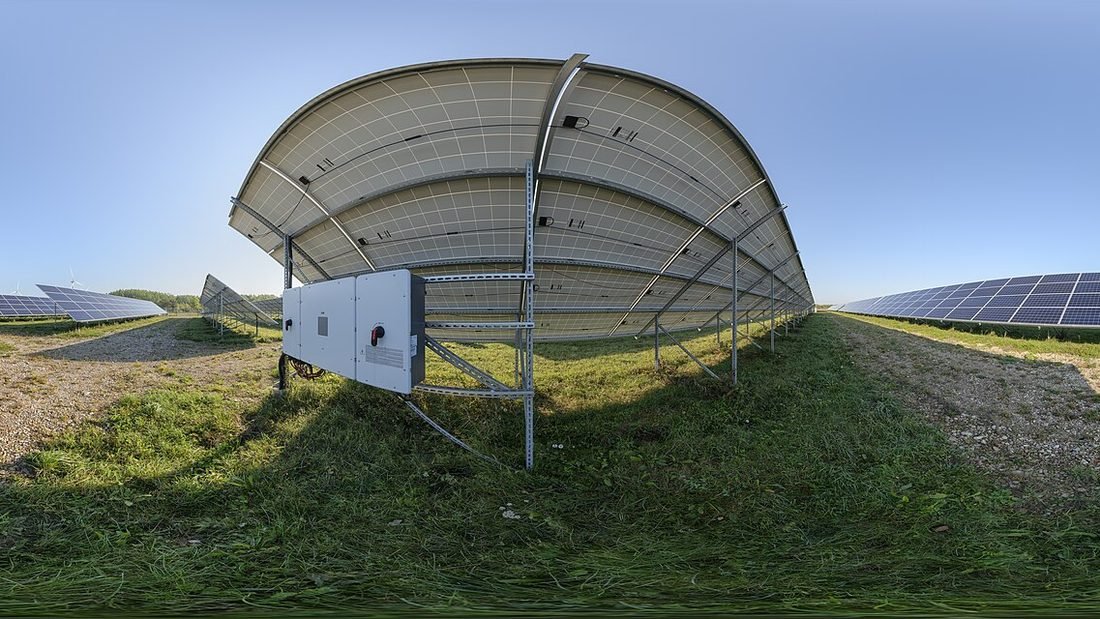
Image: Solar park inverter and mounts by Lauri Veerde, CC BY-SA 4.0, via Wikimedia Commons.
Panels get the attention, but the inverter does the work that makes the electricity usable and it is the part most likely to need servicing during a system's life. Choosing the wrong inverter, or sizing it badly, costs more than a slightly cheaper panel ever saves. This guide covers inverter types, how to size one, what the numbers on a datasheet mean and how to protect it in solar in Raipur conditions of heat, dust and storms.
Quick answer: choose an on-grid inverter from a reputable brand with local service for a standard home system, or a hybrid inverter if you want battery backup. Match its rating to the array, check the warranty, install it in a shaded, ventilated spot and protect it with surge devices.
Solar panels produce direct current. Your home runs on alternating current. The inverter converts one to the other, tracks the array's maximum power point, synchronises with the grid, shuts down safely if the grid fails and reports generation to an app. In a hybrid system it also charges and discharges the battery.
| Type | Best for | Backup in outage? | Typical considerations |
|---|---|---|---|
| String (on-grid) | Most homes with grid supply | No | Lowest cost; whole string affected by shade |
| Hybrid | Homes wanting battery backup | Yes, with battery | Higher cost; battery sizing needed |
| Off-grid | Sites without grid | Yes, with battery | No net metering or central subsidy |
| Microinverter | Complex or shaded roofs | No | Per-panel conversion; higher cost and more units on the roof |
| Power optimisers with string inverter | Partial shade | No | Middle ground in cost and complexity |
Designers compare the DC capacity of the array with the AC rating of the inverter. A DC-to-AC ratio of around 1.1 to 1.3 is common, meaning the panels are slightly larger than the inverter rating, because panels rarely hit their rated output. Check the inverter's input voltage and current range against the string design at both the hottest and coldest expected temperatures. For a 3.24 kW array of six 540 Wp modules, a 3 kW inverter is typical. Ask the installer to show the calculation rather than accept a rule of thumb.
| Line | What it tells you | What to look for |
|---|---|---|
| Rated AC output (kW) | Maximum continuous power to the grid | Matches the system and sanctioned load |
| Maximum DC input power | How much array capacity it accepts | At least as large as the array |
| MPPT voltage range | Window where it tracks maximum power | Covers hot and cold string voltages |
| Maximum efficiency | Peak conversion efficiency | High, typically around 97 - 98% or better |
| IP rating | Dust and water protection | IP65 or better for outdoor mounting |
| Protection features | Anti-islanding, surge, over-temperature | Complies with grid requirements |
| Warranty | Years of cover and who services | 5 - 10 years with local service |
Choose a shaded, ventilated, dry location that is easy to reach and close to the main panel to keep AC cables short. Keep it away from direct afternoon sun and rain, and leave clearance as the manufacturer specifies. Avoid dusty corners and places where water can pool. A well-chosen spot extends life and makes servicing easier.
Most inverters connect to an app. Learn what a normal day looks like: generation climbs through the morning, peaks around midday and falls in the afternoon. In Raipur's dry season, about 4 to 4.5 units per kW per day is typical. A sudden drop on a sunny day, or repeated fault codes, is your cue to call for service. Keep the commissioning report and the installer's service number handy.
Inverter warranties are shorter than panel warranties, so budget for a possible replacement within the life of the system. Ask whether warranty extension is available, who handles claims locally and how quickly replacements are supplied. Lower-priced unbranded inverters can look attractive, but a failure outside warranty or without local support can cost far more than the saving. See also solar panel price in Raipur for where inverter cost sits in the overall quote.
If you expect to add a battery later, choose a hybrid-ready inverter now. Verify the battery chemistry and voltage the inverter supports and the backup power rating it can deliver, which may be lower than its grid-connected rating. Our guide to solar battery storage for home in Raipur covers sizing in more depth.
| Roof situation | Better fit | Reason |
|---|---|---|
| Open, unshaded RCC roof | String inverter | Simple, efficient and lowest cost |
| Partial shade from tanks or trees at certain hours | String with optimisers or microinverters | Limits the effect of one shaded panel on the others |
| Several roof planes facing different directions | Microinverters or multiple MPPT string inverter | Each plane tracks its own maximum power |
| Very small system (1 - 2 kW) | Single compact string inverter | Fewer components to fail |
| Large commercial roof | Several string inverters | Redundancy and easier maintenance |
For most homes in Raipur with a clear roof, a single good string inverter is the sensible choice. Microinverters and optimisers cost more and add rooftop electronics that must survive the heat, so use them where shade or roof geometry justify it.
These questions matter more than any single specification. A slightly less efficient inverter that is repaired in two days beats a top-rated one that takes three weeks.
Grid-tied inverters must disconnect within moments of a grid failure. This anti-islanding protection stops the inverter feeding power into a dead line where utility staff may be working. It is why a plain on-grid system produces nothing during an outage even if the sun is shining. If you want power in a cut, you need a hybrid inverter that can isolate your home from the grid and run it from solar and battery. Our guide to on-grid vs off-grid vs hybrid explains the choice.
Finally, ask your installer to show the inverter's firmware and monitoring setup before they leave. A properly configured monitoring account, registered in your name with alerts enabled, turns a silent box into a system that tells you when something is wrong.
Ask a solar company in Raipur to name the inverter and show the sizing in your quote. Our rooftop solar installation in Raipur team does this on every project, and our guide to the best solar installer in Raipur lists what else to check. For the basics, read solar in Raipur and the subsidy page for PM Surya Ghar Yojana in Raipur. Readers elsewhere can use solar in Chhattisgarh, choose a solar company in Chhattisgarh, and study PM Surya Ghar Yojana in Chhattisgarh, solar subsidy apply online in Chhattisgarh and rooftop solar installation in Chhattisgarh.
Usually a 3 kW inverter, sometimes slightly smaller or larger depending on the module capacity and the designer's DC-to-AC ratio. The installer should show the calculation.
Common causes are heat, power surges, moisture, dust, poor ventilation and component ageing. Good installation, protection devices and shade reduce the risk.
Many last 10 to 15 years, but warranties are often 5 to 10 years. Plan for a possible replacement during the life of the panels.
An on-grid inverter works only with the grid and switches off in an outage. A hybrid inverter also manages a battery and can supply backup power during an outage.
Choose by track record, local service, warranty terms and compliance rather than origin alone. Ask who services it in Raipur and how quickly.
We name the inverter make, model, rating and warranty in every quotation. Visit C-29, Sector 3, Devendra Nagar, Raipur, Chhattisgarh 492001, call 083051 31420 or request a quote.
Looking for the best solar company in Raipur? See how solar in Raipur works, check the solar Raipur locality guide and book solar installation in Raipur with a trusted solar company in Raipur. Our checklist for the best solar company in Raipur shows what to ask. Browse every article on the solar blog, or see PM Surya Ghar Yojana in Raipur and our solar services.
Named inverter, correct sizing and a clear warranty and service path from a Raipur solar EPC team.