
0%

Panels slowly lose output. Here is how much, what speeds it up and how to read the warranty promise.
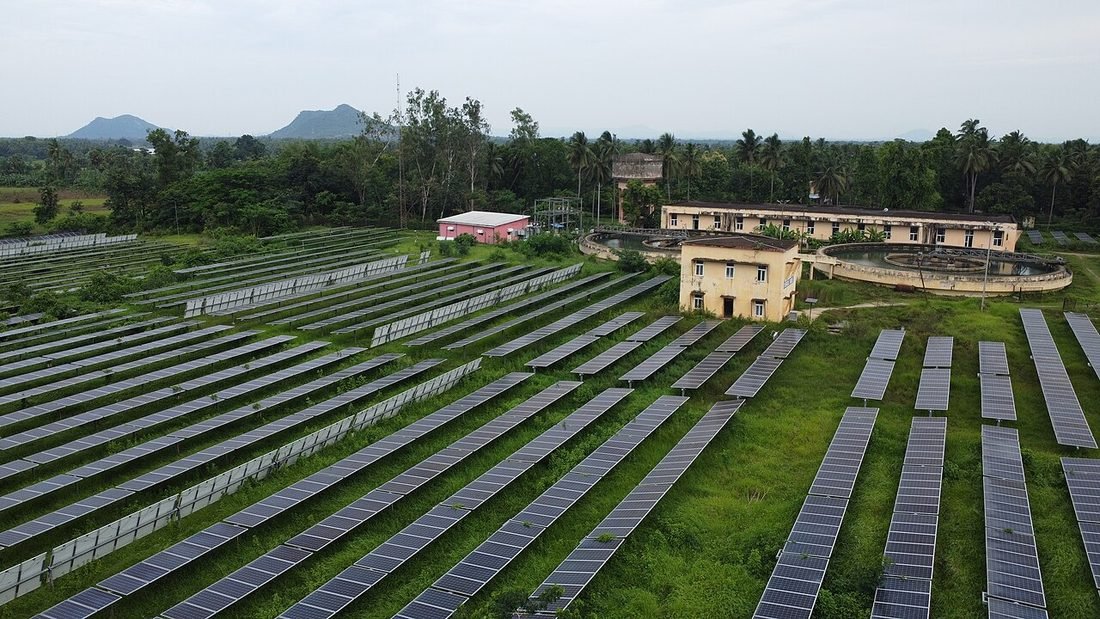
Image: Solar farm at Krishnapuram Tatipudi Water Works aerial view 01 by Saiphani02, CC BY-SA 4.0, via Wikimedia Commons.
Every solar panel gradually produces a little less each year. That is normal, and it is already baked into the manufacturers' warranties and into any honest payback calculation. Understanding it helps you read the datasheet, judge a 25-year promise and avoid being alarmed by small declines. This guide explains solar panel degradation in Chhattisgarh conditions in plain terms.
Quick answer: expect a small loss in year one and a fraction of a percent each year after, leaving roughly 80 to 87 per cent of rated output at year 25, depending on the product. Systems keep producing well beyond that.
| Year | Illustrative output as % of rated (modern mono modules) |
|---|---|
| 1 | About 98 - 99% |
| 5 | About 96 - 97% |
| 10 | About 93 - 95% |
| 15 | About 90 - 92% |
| 20 | About 87 - 90% |
| 25 | About 84 - 87% |
These figures are illustrative. Use the exact guarantee in your module's datasheet and warranty.
| Factor | Effect | What to do |
|---|---|---|
| High temperature | Accelerates some degradation mechanisms | Ventilated mounting, quality modules |
| Humidity and moisture ingress | Can corrode contacts and cells | Glass-glass or good sealing, no cracks |
| Hot spots and shading | Local overheating damages cells | Avoid shade, fix cracked modules |
| Potential-induced degradation (PID) | Voltage stress leaks current | Use PID-resistant modules and proper earthing |
| Poor installation (microcracks) | Cell breakage from rough handling | Careful handling, trained crews |
If panels lose 0.5 per cent a year, a 3 kW system producing 4,300 units in year one produces about 3,900 units in year 20. The cumulative effect on total 25-year energy is about 5 to 6 per cent below a no-degradation assumption. That barely moves payback, which happens in the first few years, but it matters for lifetime totals. See how to calculate solar payback in Raipur.
Panels do not stop working at 25 years. Many continue to produce at 80 per cent or more. At that point, the question is whether the structure, cables and inverter are still sound. Plan inspections and replace aging components as needed.
| Year | Output factor (illustrative) | Units per year (3 kW, 4,400 in year one) |
|---|---|---|
| 1 | 100% | 4,400 |
| 10 | About 95% | About 4,180 |
| 20 | About 89% | About 3,920 |
| 25 | About 86% | About 3,780 |
Adding the years together, the system delivers roughly 1.05 lakh units over 25 years, which is close to the 1,00,000 units used in our payback examples. A household that expected a flat 4,400 units a year would overestimate lifetime output by about five to six per cent. That is a rounding error next to the savings, but it is the reason honest calculations include a small decline.
Keep monthly generation figures and note cleaning dates. If a drop looks larger than a fraction of a percent a year, rule out shade, dust and inverter faults first. If the cause appears to be the panels, ask a technician to measure string voltages and currents and to inspect for hot spots and cracks. A written measurement report is the document a manufacturer asks for in a claim. See solar warranty claim process.
Degradation is predictable; surprises come from poor installation and maintenance. For the fundamentals of solar in Raipur, read our cost and savings guide, and use the solar Raipur locality guide for your neighbourhood. A local solar company in Raipur should survey your roof, our checklist for the best solar company in Raipur shows what to ask, and our solar installation in Raipur team handles the work. Browse all solar guides or read about PM Surya Ghar Yojana in Raipur.
Typically a fraction of a percent per year after a slightly larger first-year loss. Check the datasheet for the manufacturer's figures.
Warranties commonly guarantee about 80 to 87 per cent of rated output at year 25, depending on the product.
Higher operating temperatures and humidity can influence long-term degradation. Good module quality and ventilation help.
It is a guarantee of a minimum output, not a promise of identical performance. Many panels continue to produce well beyond 25 years.
Compare the same month year on year, adjusting for weather, and keep dust and shade under control.
Visit C-29, Sector 3, Devendra Nagar, Raipur, Chhattisgarh 492001, call 083051 31420 or send your details online for a free survey and a written quotation. Our solar installation in Raipur team replies the same working day.
Next, talk to a solar company in Raipur about solar installation in Raipur. Our solar in Raipur guide explains costs, the solar Raipur guide covers your area and the best solar company in Raipur checklist helps you choose. Browse every article on the solar blog, or see PM Surya Ghar Yojana in Raipur and our solar services.
Module datasheets, warranty terms and expected generation in writing.