
0%

Which solar panel technology suits Chhattisgarh's heat and your roof, and which one the subsidy rules allow.
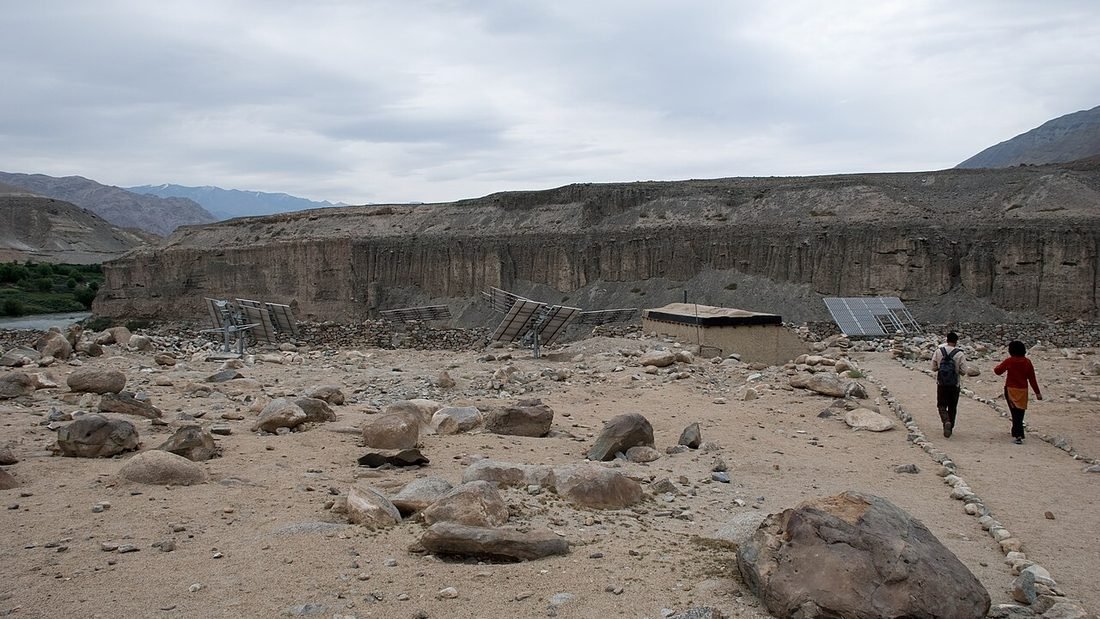
Image: View of solar panels near Leh (4337356630) by Kiran Jonnalagadda from Bangalore, India, CC BY-SA 2.0, via Wikimedia Commons.
Walk into a solar showroom and you will hear a stream of acronyms: PERC, TOPCon, bifacial, DCR. They describe how the cells inside a panel are built and where they are made. This guide explains each in plain language and says which suits solar in Chhattisgarh, where summer roofs run hot and the PM Surya Ghar rules add a compliance layer.
Quick answer: for a rooftop in Raipur or elsewhere in the state, choose mono-crystalline modules from an established manufacturer, ideally TOPCon or PERC, that meet the scheme's domestic content rules, with a clear 25-year performance warranty.
| Type | How it works | Typical efficiency range | Where it fits |
|---|---|---|---|
| Polycrystalline | Cells cut from multi-crystal silicon blocks | Roughly 15 - 18% | Legacy technology; rare in new rooftop projects |
| Mono PERC | Single-crystal cells with a rear passivation layer | Roughly 20 - 22% | Widely used, proven and cost-effective |
| TOPCon | Mono cells with a tunnel oxide passivated contact layer | Roughly 22 - 24% | Increasingly standard in new modules |
| HJT | Hybrid of crystalline and thin-film layers | Roughly 22 - 24% | Premium, lower temperature loss, higher price |
| Bifacial (any cell type) | Collects light on both faces | Adds output from the rear face | Best on raised or ground-mounted systems |
Efficiency ranges are indicative and change as technology improves. What matters on a roof is the power per panel, the price per watt and the warranty, not the efficiency number in isolation.
Panels lose power as they heat up, described by the temperature coefficient of power. A lower, less negative figure means smaller losses on a hot roof. On a Raipur summer afternoon, panel temperature can be well above ambient. TOPCon and HJT modules commonly list better temperature coefficients than older PERC modules, so they can hold slightly more of their rated output in hot weather. The gain is real but modest; compare datasheets rather than assume.
Mono modules deliver more watts per square metre, which matters when roof space is limited. Polycrystalline modules were popular a decade ago because they were cheaper, but the price gap has largely disappeared and the market has moved to mono. For a new system, there is rarely a good reason to choose polycrystalline.
Bifacial modules generate extra power from light reflected onto the back of the panel. On a white or light reflective roof with a raised structure, the gain can be noticeable. On a typical dark rooftop with panels close to the surface, the gain is small, so do not pay a large premium for it. Ask the installer to explain the expected benefit for your specific roof.
For a PM Surya Ghar subsidised system, modules must meet domestic content rules, and the approved lists of manufacturers have been updated through 2026. A "made in India" label is not enough. The cells must also be domestic for a module to qualify as DCR. Our explainer on DCR modules and ALMM List-II sets out what to ask for.
| Line on the datasheet | What it tells you | What to look for |
|---|---|---|
| Rated power (Wp) | Output under standard test conditions | Consistent with the quote and the panel count |
| Module efficiency | Share of sunlight converted | Higher means more watts per square metre |
| Temperature coefficient of Pmax | Power loss per degree above 25 C | A smaller negative number is better in heat |
| First-year degradation | Output drop in year one | Lower is better |
| Annual degradation | Yearly drop after year one | Lower is better |
| Performance warranty | Guaranteed output over time | 25 to 30 years with a clear year-25 figure |
| Product warranty | Defects in materials and workmanship | Longer is better; ask who honours it locally |
Modern high-wattage panels have higher voltage and current, so the inverter must be compatible. A good installer checks string voltage against the inverter's input range at both the coldest and hottest temperatures. This is part of design, not something a homeowner needs to calculate, but it is a good question to ask.
For most homes in Chhattisgarh, a mono PERC or TOPCon module from an established, listed manufacturer with documented domestic content, a clear 25-year performance warranty and strong local service is the sensible choice. Pay extra only for features that your roof and budget can actually use.
A more efficient panel does not change your bill on its own. What changes the bill is how many watts you can fit on your roof, how well the panel holds its output in heat and how long it lasts. On a roof with plenty of space, a cheaper standard-efficiency panel and a few extra panels may give the same capacity at a lower price. On a small roof, higher-wattage modules let you reach your target capacity at all. Ask your installer to compare capacity and price per watt, not efficiency percentages.
You may hear terms such as half-cut cells and multi-busbar designs. Half-cut cells reduce resistive losses and can improve shade tolerance, because the panel is divided into sections that operate somewhat independently. Multi-busbar designs reduce the distance current travels in each cell. These are features of nearly all modern modules and are not usually a reason to prefer one product over another, but they are good signs that a datasheet describes a current design.
| Construction | Pros | Cons |
|---|---|---|
| Glass-backsheet | Lighter, widely available, lower price | Backsheet can age under heat and UV |
| Glass-glass | Durable, good against moisture, common in bifacial modules | Heavier, sometimes costlier |
For most rooftops, either works if the manufacturer is reputable and the warranty is clear. Glass-glass modules are attractive in humid and hot climates, but weigh more, so check the roof's load capacity.
Ask. A quotation that names the manufacturer and model number lets you look up the datasheet and confirm the cell technology, wattage, efficiency, temperature coefficient and warranty. If the installer cannot or will not name the model, that is a red flag. Keep the datasheet and the DCR certificate with your commissioning papers.
Pick the well-known manufacturer whose product is on the current approved list, whose warranty you can read and whose local service you can reach. Then compare price per watt among two or three such options. Anything else is secondary for a home rooftop.
One more point: technology moves quickly. A module that is premium today becomes standard in a couple of years. Buy what is proven, documented and supported now, rather than paying a large premium for a feature that may soon be commonplace.
Compare prices in solar panel price in Raipur, then confirm compliance with our DCR guide. Our rooftop solar installation in Chhattisgarh team specifies named modules in every quote, and a local solar company in Chhattisgarh should stand behind the warranty. For the broader picture, read solar in Chhattisgarh and PM Surya Ghar Yojana in Chhattisgarh, then the steps to solar subsidy apply online in Chhattisgarh. In Raipur, see solar in Raipur, ask an established solar company in Raipur to survey your roof, compare firms with the best solar installer in Raipur checklist, learn about PM Surya Ghar Yojana in Raipur and book rooftop solar installation in Raipur.
Mono-crystalline modules, in PERC or TOPCon form, are the standard choice. TOPCon modules often have a lower temperature coefficient, which helps in hot Chhattisgarh summers, but the right choice also depends on price, warranty and scheme compliance.
Rarely for new rooftop systems. They are less efficient than mono modules and are now uncommon in subsidised installations.
Bifacial modules collect light on the back as well, but on a typical dark or low roof the gain is small. They help more on ground-mounted or raised installations with reflective surfaces.
For a PM Surya Ghar subsidised system, yes: the modules must meet the domestic content rules. Ask for the manufacturer's documentation in writing.
Most manufacturers offer a 25 to 30 year linear performance warranty, but the guaranteed output in year 25 differs between products. Read the datasheet rather than the brochure headline.
We name the module make, model and compliance documents in every quotation. Visit C-29, Sector 3, Devendra Nagar, Raipur, Chhattisgarh 492001, call 083051 31420 or request a quote.
Next, talk to a solar company in Raipur about solar installation in Raipur. Our solar in Raipur guide explains costs, the solar Raipur guide covers your area and the best solar company in Raipur checklist helps you choose. Browse every article on the solar blog, or see PM Surya Ghar Yojana in Raipur and our solar services.
Named modules, datasheets and DCR documents in one quotation from a PM Surya Ghar registered vendor in Raipur.