
0%

An electric vehicle and a rooftop system make a natural pair. Here is how to size them together and what it saves.
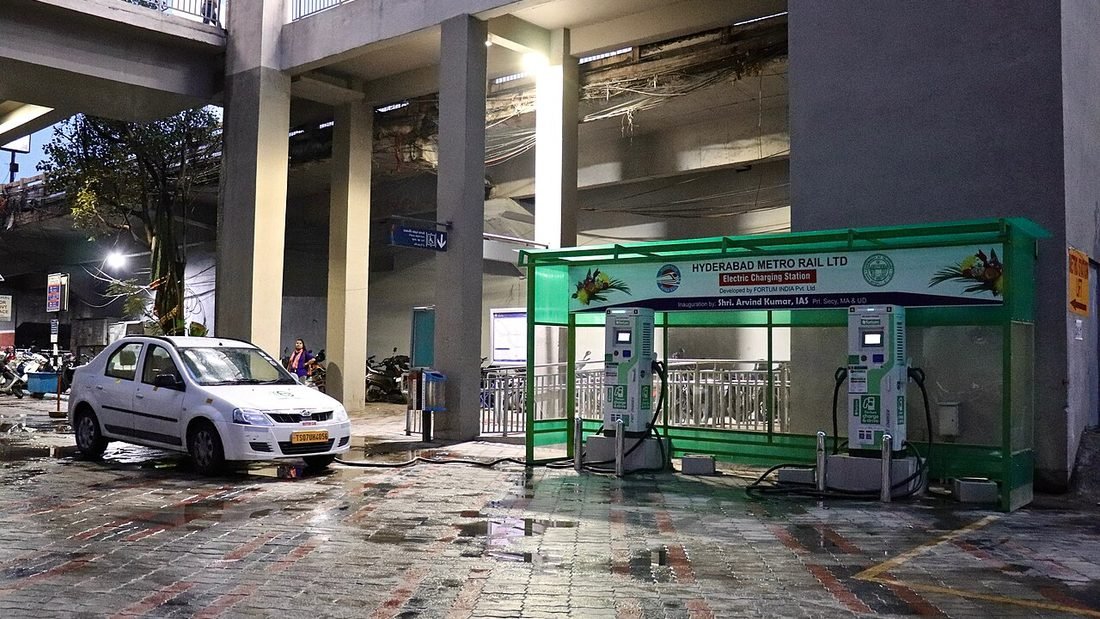
Image: Electric car charging station in Begumpet, Hyderabad by iMahesh, CC BY-SA 4.0, via Wikimedia Commons.
Electric vehicles are arriving in Raipur, and their owners quickly notice that a vehicle is just another electricity bill. Pair it with rooftop solar and the maths improves: you generate the energy you consume, and the grid works as your battery. This guide explains how to size solar and EV charging at home in Raipur, how net metering handles night charging and what to check before installing a charger.
Quick answer: add roughly 1.5 to 2 kW of solar for every 40 km of daily EV driving in a car, install a suitable home charger and make sure your sanctioned load and wiring can take it. Net metering lets daytime solar offset night charging.
Most people charge at night, while the sun is down. With a grid-tied system and net metering, daytime generation that exceeds your home's use goes to the grid and earns credit. At night, the vehicle draws from the grid, and the bidirectional meter nets the two. On paper, your solar offsets your charging even though the electrons do not arrive in the same hour. Check your distribution company's net-metering settlement terms, because the treatment of surplus can be revised.
| Vehicle use | Approx. efficiency | Daily energy | Extra solar needed (Raipur) |
|---|---|---|---|
| Electric scooter, 30 km a day | About 25 - 30 km per unit | 1 - 1.2 units | About 0.3 kW |
| Small electric car, 30 km a day | About 6 km per unit | About 5 units | About 1.2 kW |
| Electric car, 40 km a day | About 6 km per unit | About 7 units | About 1.6 - 1.8 kW |
| Electric car, 60 km a day | About 6 km per unit | About 10 units | About 2.4 - 2.6 kW |
Real efficiency varies by model, driving style and air conditioning. Add the figure to your household's requirement. A home using 300 units a month with a daily 40 km EV commute might move from a 3 kW to a 5 kW system. Read 3 kW vs 5 kW to see the trade-offs.
Grid power at a domestic tariff makes electric driving cheaper per kilometre than petrol. Solar-generated power, whose cost per unit over the life of the system is far lower than tariff, makes it cheaper again. The saving is real but depends on petrol price, tariff slab and your vehicle's efficiency, so compare with your own numbers instead of a headline claim.
An EV charger can add several kilowatts of load for hours. Check your sanctioned load against the charger, the wiring from the meter to the charging point, the breaker rating and earthing. Use a dedicated circuit with an appropriate RCD. Have a qualified electrician certify the installation. If your load needs to increase, apply to the distribution company before you buy the charger.
If you work from home or can charge during the day, charging while the sun is up uses solar directly and reduces net-metering dependence. Some chargers and inverters can be set to charge only from surplus solar. This is optional for most households, because net metering already offsets night charging financially, but it is an elegant option for those who can use it.
For apartments, the PM Surya Ghar provision for housing societies and RWAs supports solar for common facilities, including EV charging, at Rs 18,000 per kW, up to 500 kW. A shared rooftop plant can feed common charging points and reduce charging costs for residents. See solar for apartments and housing societies in Raipur for the process.
The central rooftop subsidy applies to eligible residential systems up to 3 kW. If you add capacity for an EV beyond 3 kW, the extra is unsubsidised, though it pays back through avoided fuel and electricity cost. Chhattisgarh has announced a state top-up for domestic consumers; confirm current slabs. Read PM Surya Ghar Yojana in Chhattisgarh for details.
A family in Raipur uses 350 units a month for the house, drives an electric car about 35 km a day and rides an electric scooter about 20 km a day. The car uses about 6 units a day and the scooter about 0.8. Together the vehicles add about 6.8 units a day, or about 205 units a month. Total household need rises from about 350 to about 555 units a month, which suggests roughly 4.5 to 5 kW of solar. The family chooses a 5 kW system with ten 540 Wp panels, pays about Rs 1.8 to 2.2 lakh after the central subsidy and offsets both house and vehicle electricity. The sums vary with usage, but the method is the same: add vehicle energy to household energy and size from the total.
Some distribution companies offer time-of-day tariffs or special EV tariffs, which may make night charging cheaper or more expensive than the standard slab. Ask your distribution company what applies to a home EV charger and whether a separate connection or meter is needed. If you use a separate EV connection, check how net metering applies to it. These rules vary and change, so confirm them before investing in a charger.
If you are buying an EV soon, speak to a solar installer before you buy the charger. The same visit can check your load, meter board and roof. If you already have solar, ask whether your inverter and net-metering arrangement are fine with the added night draw, and whether a larger sanctioned load is needed. Keep an eye on charger standards and warranties, because the market is changing quickly, and prefer products with local service.
If your roof is heavily shaded, if you rent without roof rights or if your vehicle travels very little, a separate EV-focused solar plan may not pay off. In those cases, charge from the grid, enrol in any EV tariff that applies and revisit solar when your situation changes. Solar and EVs are a natural pairing, but only when the roof, the load and the budget line up.
Start with the fundamentals in solar in Raipur, then ask a solar company in Raipur to size your system for house and vehicle. Our rooftop solar installation in Raipur service includes survey, design and paperwork, and the PM Surya Ghar Yojana in Raipur page explains the subsidy. Compare installers with the best solar installer in Raipur checklist. Beyond Raipur, read solar in Chhattisgarh, how to pick a solar company in Chhattisgarh, the steps for solar subsidy apply online in Chhattisgarh and what rooftop solar installation in Chhattisgarh involves.
Yes. A grid-tied rooftop system generates units during the day and the net meter credits them against what you draw, including at night when you charge the vehicle. The effect is that solar offsets your charging energy.
An electric car that travels 40 km a day at about 6 km per unit uses roughly 7 units a day, which needs about 1.5 to 2 kW of extra solar in Raipur. Add that to your household requirement.
A slow AC charger or a basic wall box is enough for overnight charging. Faster chargers need adequate sanctioned load, wiring and protection.
Charging adds load. Check your sanctioned load and the wiring and breaker capacity before installing a charger, and apply for a load increase if needed.
Yes. The PM Surya Ghar provision for societies supports common facilities, including EV charging, at Rs 18,000 per kW up to 500 kW. Confirm eligibility and current rules.
Tell us your car or scooter model and daily distance and we will size solar for the whole household. Visit C-29, Sector 3, Devendra Nagar, Raipur, Chhattisgarh 492001, call 083051 31420 or request a survey.
Next, talk to a solar company in Raipur about solar installation in Raipur. Our solar in Raipur guide explains costs, the solar Raipur guide covers your area and the best solar company in Raipur checklist helps you choose. Browse every article on the solar blog, or see PM Surya Ghar Yojana in Raipur and our solar services.
A combined sizing for house and vehicle with net cost, running cost per kilometre and subsidy worked out.