
0%

Air conditioners are the biggest summer load. Here is how much solar they need and whether a battery is worth it.
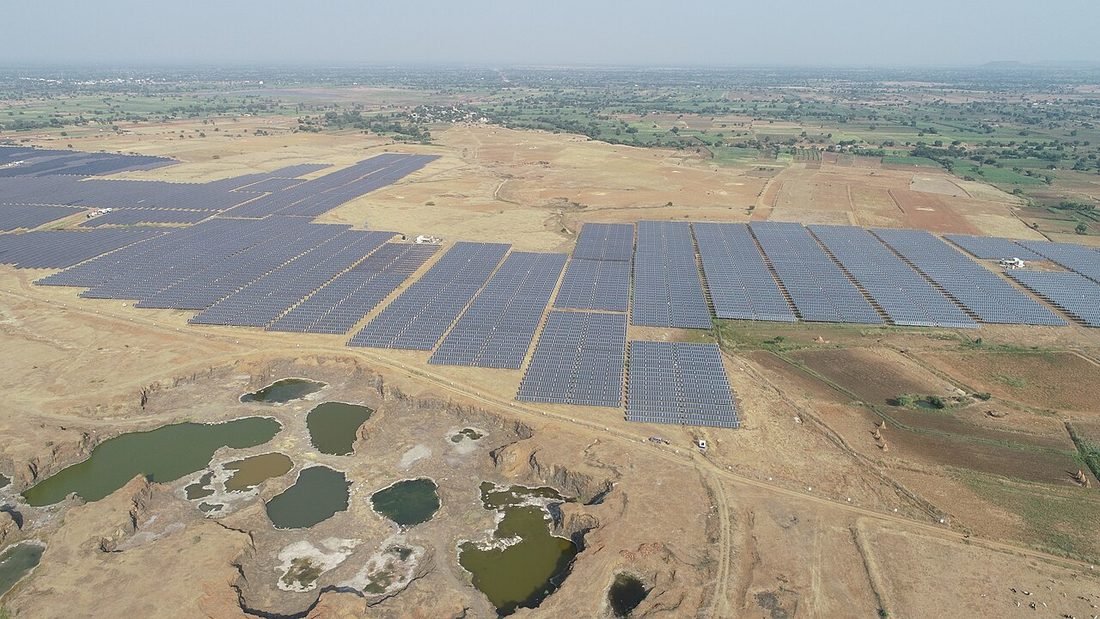
Image: Solar Power Plant Maharashtra I in state of Maharashtra, India, 67.... by Thomas Lloyd Group, CC BY-SA 4.0, via Wikimedia Commons.
In Raipur, summer is long and air conditioners run for months. They are also the largest single reason bills jump from Rs 2,000 to Rs 6,000. It is natural to ask: can solar run an air conditioner in Raipur? The answer is yes, with a few caveats about night-time use. This guide shows how to size the panels, why net metering usually beats batteries for ACs and what the economics look like.
Quick answer: a 1.5 ton inverter AC used eight hours a day needs about 2 to 3 kW of extra solar. Daytime use is covered directly; night-time use is covered by net-metered credit rather than a battery in most homes.
| AC type | Typical running power | Units per hour (approx.) | Units for 8 hours |
|---|---|---|---|
| 1 ton inverter | 0.7 - 1.0 kW | 0.7 - 1.0 | 6 - 8 |
| 1.5 ton inverter | 1.0 - 1.5 kW | 1.0 - 1.5 | 8 - 12 |
| 2 ton inverter | 1.5 - 2.0 kW | 1.5 - 2.0 | 12 - 16 |
| 1.5 ton fixed-speed | 1.5 - 2.0 kW | 1.5 - 2.0 | 12 - 16 |
Real consumption varies with room size, insulation, set temperature and outdoor heat. Inverter models modulate power and use less on average than fixed-speed units.
If the AC runs mostly in the afternoon, solar feeds it directly. If it runs mainly at night, solar energy produced earlier is exported and credited, then drawn back at night. Net metering turns the grid into a battery with some rules and limits. A real battery to run a 1.5 ton AC for eight hours at night would need 10 to 15 kWh of usable storage, which adds a large cost. Most households choose net metering.
| Approach | Extra cost | How the AC is powered at night | Comment |
|---|---|---|---|
| Net metering with extra solar | About Rs 1.0 - 1.3 lakh for 2 kW more capacity before subsidy effects | Grid, offset by credit | Simple, lowest cost |
| Hybrid with battery | Rs 1.5 - 3 lakh or more for storage | Battery then grid | Backup during cuts, higher cost |
| No solar | Nil | Grid at full tariff | Highest running cost |
A family in Avanti Vihar has two 1.5 ton inverter ACs, each run about 8 hours in summer. Daily AC use is about 18 units. Adding 4.3 kW of solar to cover that, on top of 3 kW for the rest of the house, suggests a 7 to 8 kW system. The family chooses 6 kW, covering most of the AC load, and uses fans in shoulder months. They keep the subsidy for the first 3 kW and pay the balance for the extra capacity. The saving in summer is large, and the system pays back through avoided higher-slab units.
A couple runs a 1.5 ton inverter AC in the bedroom from 10 pm to 6 am, about 8 hours, using roughly 7 to 9 units a night. During the day the AC is off, so none of its use coincides with solar generation. Under net metering, an extra 2 kW of solar generates about 8 to 9 units a day, which is exported and credited, and the bedroom AC draws it back at night. Their annual bill for the AC falls close to zero in net terms, though the meter still shows imports at night and exports in the day. The family needs no battery. The cost of the extra 2 kW is about Rs 1.0 to 1.3 lakh before any subsidy considerations, and it pays back through avoided high-slab units.
To run the same AC in a cut, you need a hybrid inverter that can supply its start-up surge and a battery of 8 to 10 kWh or more for a night. That adds a large cost. Many households choose a smaller solution, such as a fan and light backup, and accept that the AC will stop in a cut. Others pair solar with a generator. Decide whether AC backup is a necessity or a luxury before you price it.
| Measure | Typical effect on AC energy |
|---|---|
| Setting 25 or 26 degrees instead of 22 | Noticeable reduction |
| Cleaning filters regularly | Restores efficiency |
| Shading the west wall and window | Reduces heat load |
| Roof insulation or reflective paint | Reduces heat gain |
| Upgrading to a five-star inverter model | Large reduction compared with an old fixed-speed unit |
Each unit you avoid is a unit you do not need to generate, so cooling efficiency and solar sizing go hand in hand.
Solar is the cheapest way to run the most expensive appliance in the house. If you are comparing providers, start with our guide to the best solar company in Raipur, then ask a solar company in Raipur for a written quote. Our solar installation in Raipur crews work across the city, the solar Raipur area guide explains local roof and shade patterns, and the main solar in Raipur guide covers costs. The full blog has more, and PM Surya Ghar Yojana in Raipur explains the subsidy.
Yes. A 1.5 ton inverter AC uses roughly 1.2 to 1.5 kW while cooling, so about 2 to 3 kW of solar can cover its daytime use. At night it draws from the grid, offset by net metering.
Roughly four to six 540 Wp panels cover one 1.5 ton AC's average daytime consumption, depending on hours of use.
A battery large enough for an AC is expensive. Most homes use net metering so that daytime surplus offsets night-time grid use instead.
Yes. Inverter ACs draw less power and have softer starts, so they suit solar and smaller inverters.
It can remove most of the energy cost of the AC if the system is sized for it. Savings depend on hours of use and tariff slab.
Visit C-29, Sector 3, Devendra Nagar, Raipur, Chhattisgarh 492001, call 083051 31420 or send your details online for a free survey and a written quotation. Our solar installation in Raipur team replies the same working day.
Looking for the best solar company in Raipur? See how solar in Raipur works, check the solar Raipur locality guide and book solar installation in Raipur with a trusted solar company in Raipur. Our checklist for the best solar company in Raipur shows what to ask. Browse every article on the solar blog, or see PM Surya Ghar Yojana in Raipur and our solar services.
A written sizing that includes your ACs, net metering and optional backup.